

Made-to-order & bespoke manufacturing
For businesses where every quote, job and bill of materials is different — and the software has to be built for that, not adapted to it.
Some businesses make the same product all year and hold it in stock. This page is for the others: the trophy engraved with a winner’s name, precast concrete poured to a structural drawing, furniture finished to a designer’s specification. In these businesses an order isn’t picked from a shelf — it’s specified, priced and built, one at a time. Inventory software is mostly built for businesses that sell what they stock. Workhorse is configured around businesses that make what they sell.
The quote is the job
In a made-to-order business, the quote is where money is won or lost. It has to hold the full specification — dimensions, materials, finishes and options — and price it from materials and labour that differ every time.
A precast manufacturer quotes from the engineer’s drawing:
Mould time, mix, reinforcement, lifting fittings, delivery. Two castings that look similar on paper can carry very different costs, and the margin lives in that difference. Then the quote has to become the job. In most systems a quote is a product line and a price, so a won quote gets re-keyed into a spreadsheet, a whiteboard or a second system to be made and the specification the customer agreed to starts drifting from the one the workshop is building.

If quoting takes nearly as long as making, or every win is typed in twice, you’re on the right page.
Where is order 214?
Once won, every order becomes a job moving through stages — and with thirty live jobs at different points, the question “where is order 214?” needs an answer that doesn’t involve walking the floor.
A furniture workshop needs to see which jobs are at finishing, which are waiting on hardware, and which were promised for the 14th — in one view, with the promise dates attached.
Without that view, the schedule lives in one person’s head or on a whiteboard, delivery dates get promised against stock and capacity nobody has checked, and the first sign of a late job is the customer’s phone call.
If your production schedule can’t survive one person’s holiday, this is the pattern.
A bill of materials per order, not per product
Standard inventory software assumes a product has a fixed bill of materials: build the same thing, consume the same parts. Made-to-order businesses compose a BOM per job. A lampshade maker’s “same” shade never consumes the same components twice — this frame size, that customer’s fabric by the metre, this trim, that fitting.
The BOM has to be built with the order, drive what gets purchased or drawn from stock for that job, and capture what the job actually consumed — because whether it made money is only knowable afterwards, at actual cost.

If your BOMs live in a spreadsheet because the system wants one BOM per product, that’s the gap.
The promise date is a chain, not a guess
A single job rarely comes from one place. A security door maker buys the steel from one supplier and the glazing from another, and sends frames out for powder-coating between fabrication and final assembly.
Each step depends on something — a purchase order landing, an outsourced process coming back, a previous work order finishing — and the date promised to the customer is really promised against the slowest link in that chain.
When purchase orders, work orders and the job live in separate systems, nobody sees the dependency until it breaks: the PO that slipped a week quietly takes the job with it, and the schedule finds out last.
If one late delivery regularly reshuffles your whole workshop, this is why.
One record from quote to invoice
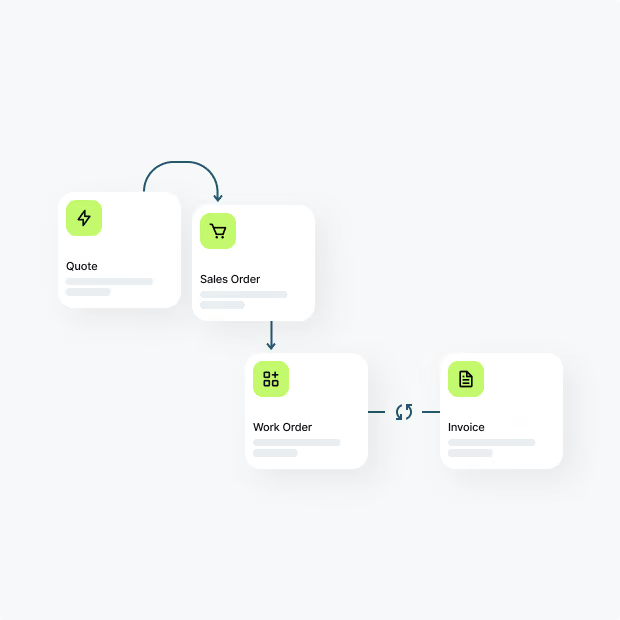
Workhorse treats the quote, the job and the bill of materials as one connected record. The quote captures the full specification and prices it from materials and labour. Won, it becomes the sales order and the works order without re-keying — the spec the customer agreed is the spec the workshop builds. Each job carries its own BOM, which raises the purchase orders and stock allocations for that job — across however many suppliers it takes — and work orders follow one another in sequence, so a late PO shows up against the jobs it delays.
.svg)
Production is tracked through your stages, under your stage names, with promise dates visible against real component availability. The promise date stops being a guess: it’s read off the slowest link in the chain, and when a link slips, you see which jobs slip with it. When the job ships, the actual costs are on it, and the invoice syncs to Xero.

Every Workhorse system starts as the complete platform
Quotes, sales orders, stock, purchasing, work orders, despatch, invoicing and reporting — and is configured to the way you quote, build and cost during a managed implementation: your specification fields, your quote and job documents in your branding, your production stages under your names, your costing method. Where a job runs through a process nothing off the shelf can describe, we build for it. How that works is set out on our configuration & customisation page.
Standard inventory software expects every order to be the same product, built the same way, from the same bill of materials. In a made-to-order business, variation is the normal case — so Workhorse is configured around the way you quote, build and cost, not the other way round.
"The implementation team quickly understood our business and the technical bespoke requirements we had."
- Jason Andrews, CEO - IN2 Access
.svg)
Read their stories on our customers page. See also our furniture & interiors and manufacturing pages.
If you make a standard range to stock and orders pick from it, you don't need this pattern.
Our wholesale & distribution page describes your operation better. It's when variation is the normal case that a system configured to your workflow starts paying for itself.
Bring us a real recent quote, with all its options and awkward variations and we’ll show you how it runs through Workhorse.
From first pricing to final invoice.